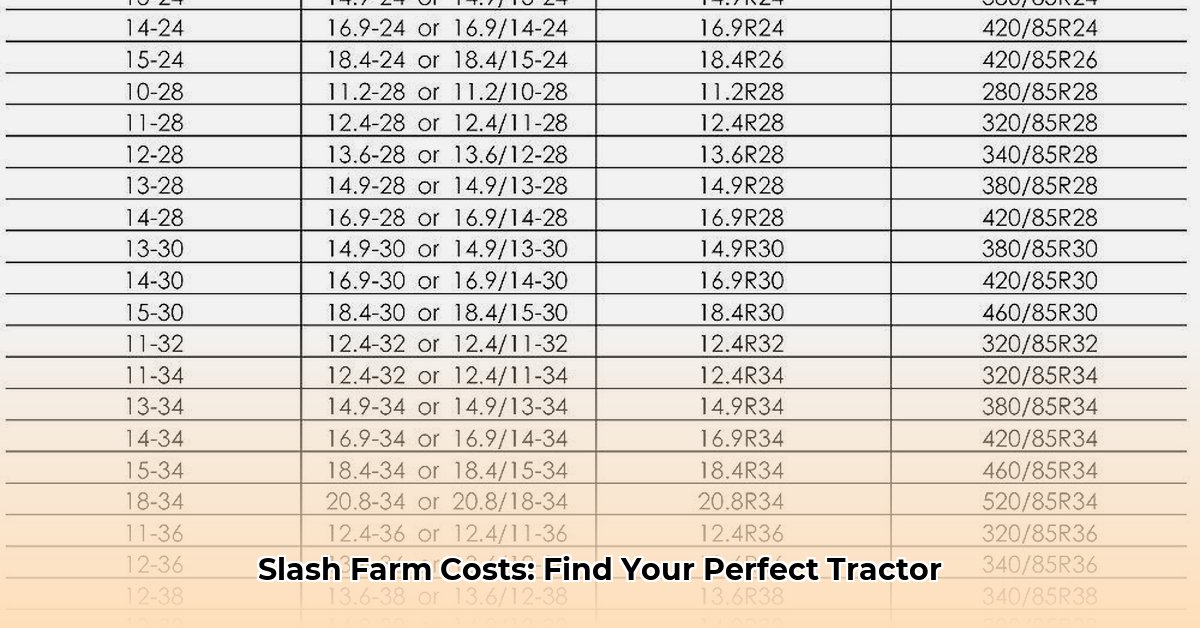
Choosing the right tractor can significantly impact your farm's profitability and sustainability. Many farmers unknowingly use oversized tractors, leading to increased fuel consumption, higher maintenance costs, and unnecessary soil compaction. This comprehensive guide will walk you through optimizing your tractor size using a calculator like CATSS (or similar software), enabling you to make informed decisions and maximize your farm's efficiency. To better understand fuel costs, check out this helpful resource on tractor fuel costs.
Understanding Tractor Sizing: Key Factors to Consider
Selecting the appropriate tractor involves more than just horsepower. Several crucial factors influence the optimal size for your operation:
Horsepower (HP): The power of your tractor (in horsepower). This must match the power demands of your implements (e.g., plow, planter). Insufficient horsepower leads to inefficient operation, while excessive horsepower wastes fuel and increases wear.
Implement Width: The width of your farming equipment directly impacts the required tractor power. Wider implements generally require more powerful tractors.
Field Conditions: Terrain plays a significant role. Steep slopes, rocky areas, or heavy, wet soil demand different tractor specifications compared to flat, well-drained fields. A smaller, more maneuverable tractor may be preferred on hilly terrain to prevent rollovers.
Soil Type: Soil type impacts the tractor's power needs. Clay soil, for instance, requires more power than sandy soil due to increased resistance.
Crop Types: Different crops have varying requirements. Large-scale operations might need larger tractors for efficient coverage, while specialized crops may benefit from smaller, more precise equipment.
How much horsepower do you really need? Oversizing leads to wasted fuel and unnecessary wear, impacting both your bottom line and the environment.
Tractor Size Calculators: Your Smart Farming Partner
Tractor size calculators, such as CATSS, leverage sophisticated algorithms to simplify tractor selection. These tools consider all the key factors discussed earlier, providing a personalized recommendation tailored to your specific farming operation. Using such software minimizes costly mistakes and boosts your farm's overall efficiency and sustainability.
How to Use a Tractor Size Calculator: A Step-by-Step Guide
Using CATSS (or a similar tool) is straightforward. Follow these steps for optimal results:
Step 1: Data Collection: Laying the Foundation
Begin by gathering essential information:
- Total acreage: The total area of your farmland.
- Field geometry: The shapes and sizes of your fields (square, rectangular, irregular). This impacts the calculation of time and fuel needed.
- Soil type: Precise soil classification (e.g., clay, sandy loam). This is crucial for accurate power estimations.
- Typical weather: Consider average rainfall, drought frequency, and other climatic factors.
- Planned implements: List all equipment you'll use (plow, planter, cultivator, etc.), including their size and weight.
- Field slope: Document the average slope of your fields. Steeper slopes influence tractor power requirements significantly.
Step 2: Data Input: Feeding the Algorithm
Input the collected data into the CATSS software. Most calculators use intuitive interfaces, guiding you through each input field. Double-check your entries for accuracy; incorrect data leads to unreliable recommendations.
Step 3: Calculation: Generating the Recommendation
Once all data is entered, initiate the calculation. The software will process the information, considering all parameters, generating a horsepower recommendation and other relevant specifications.
Step 4: Review and Refinement: Critical Analysis
Examine the results critically. Do the recommendations align with your experience and expectations? If not, revisit your input data. The process is iterative; fine-tune your input as needed for optimal results.
Integrating CATSS with Existing Farm Management Systems
Integrating CATSS or similar software with existing farm management systems streamlines your workflow. Check your system's documentation for integration instructions. Even if direct integration isn't possible, manually transferring the CATSS output is valuable for centralized data management. Combining data from CATSS with other precision farming tools like GPS guidance optimizes your entire operation.
Cost-Benefit Analysis: Quantifying the Returns
Proper tractor sizing delivers substantial financial benefits. These include:
- Lower fuel consumption: Reduces operating costs.
- Reduced maintenance: Less strain on components means fewer repairs.
- Minimized soil compaction: Better soil health and long-term productivity.
- Increased efficiency: Faster task completion, leading to higher overall productivity.
Are you ready to see the significant savings that proper tractor sizing offers? The investment in a tractor sizing calculator quickly pays for itself.
Limitations and Considerations: A Balanced Perspective
While CATSS and similar tools are invaluable, they have limitations:
- Data Accuracy: Inaccurate input generates inaccurate results.
- Regional Variations: Local conditions significantly impact tractor requirements.
- Unforeseen Circumstances: Calculators cannot account for weather anomalies or unexpected equipment failures.
- Other Factors: Labor, financing, and market prices are also critical elements in your decision-making process.
Conclusion: Embracing Data-Driven Decision Making
Using a tractor size calculator like CATSS empowers you to make informed, data-driven decisions, optimizing tractor selection for increased efficiency and profitability. Remember that the calculator is a tool; your experience and knowledge of your farm remain paramount. Embrace data-driven methods and build a more sustainable, profitable farming operation.